
We're finally over our jet-lag from the long-awaited trip to India. It was really quite wonderful, and we'd like to share some of our favorite memories, along with photos. Above, we are at the very end of the trip when we went to the Taj Mahal with two other adventurous travelers and our guide, Jai.
New Delhi Feb 5-8.
Our welcome dinner was at one of the best restaurants in India, Indian Accent. Traffic was snarled most of the way there. The meal was exceptional, a good start to our trip. It was small plates, which the chef explained were re-inventions of classic Indian dishes. Each dish was inventive, flavorful with a mix of Indian flavors and artistic, things like Pulled Kathal Phulka Taco and Paneer Lasagna with go ji berry makhni.

On Monday after another difficult drive through Delhi traffic we made our way to Old Delhi. We had a very brief look at the Red Fort, and then walked into the market area. The narrow streets were filled with a chaotic and noisy mix of people, vehicles of every type and animals of every kind. We were loaded onto bicycle rickshaws and then weaved our way through the maze of traffic, coming oh-so-close to collision with vehicles bigger and smaller than our rickshaw. The driver was incredibly strong and skilled. It was a 5 star amusement park ride.

We made our way to the spice market where we saw a dazzling array of spices, and purchased some that are hard to find in the U.S. Lunch was at a Haveli, an old mansion converted on the ground floor into a restaurant. The food featured starters that were versions of street food and quite tasty. It was 4 or so when we were done, so we rode in cabs that took us slowly through the afternoon chaos of traffic to our hotel. It was India, a riot of sound sights, smells, streets congested with vehicles and people. Lots of poverty and energy.
On Tuesday, we did a drive by the main government buildings and India Gate, a memorial to those who died in war. Then we went to a typical middle-class Indian home in a suburb of New Delhi. The woman of the house and her 80 year old mother showed us how to prepare several Indian dishes. According to the wife, in the south, dishes tend to be dominated by one spice or flavor while in the north there is more blending of spices. She then prepared a series of wonderful dishes and breads and condiments. It was an incredibly wonderful meal, with each dish distinct and flavorful.
On Wednesday, we got up early to catch a train to Jaipur. The station was crowded but not overwhelming, though we were happy to be with our guides, since signage was not good. We were booked on a "fast" train to Jaipur. It turned out to be on the old side and not particularly fast. The inside was a bit worn and shabby, but comfortable. There was a constant service of hot water for tea or coffee and food.
Jaipur Feb 8-11
After arriving in Jaipur, we had lunch and a cooking demonstration at a haveli, (stately home) called Dera Mandawa. The owner, Thakur Durga Singh, was from an aristocratic family (the Mandawa) who had turned his home into a guest house. He had also become an active promoter of working with natural and local foods and conducting agriculture in sustainable ways. He produced some of his own food and worked with other local producers.
The focus was on Rajisthani cuisine. We began the cooking with his explanation of the use of cow dung as cooking fuel. This was a traditional way that soldiers cooked with in the Rajasthani desert. Use of dung, which is plentiful, reduces the need for wood. We had pieces of chicken cooked on skewers over a hot fire. Then he showed how you could turn the fire into an oven and baked rolls, which turned out crispy with a smoky flavor. Throughout the day he talked about local traditions and sustainable approaches to agriculture.

We then had a cooking demonstration and discussion by his wife. She talked about tempering spices and made a couple of dishes. We then sat down to a wonderful meal with our hosts.
Our hotel in Jaipur was another haveli. Samode Haveli had served as a residence fcr courtiers who visited the King of Jaipur. It had a rippled ramp leading to the main entrance so that elephants could walk up (and a wonderful turbaned guard who graciously helped Judy navigate it each time). Inside was a courtyard with a fountain. There was another courtyard behind the main building filled with flowers, a swimming pool and a restaurant. Some were off winding corridors designed to give courtiers privacy. We had a large room off a small courtyard that was quite comfortable.

We started out the day with a trip to the Amber Fort, a large fortress on a rocky precipice that was constructed in the 16th century and served as a royal palace for the Rajputs, the local kings. When the population in the town that arose outside the fortress grew too large for the available water supply, King Jai Singh II , moved the capital to a new area, where he designed Jaipur.
The fort was magnificent, massive and elegant. It had many clever touches like grass curtains hung from hooks that when wetted down cooled the rooms inside--an early version of air conditioning. The city's founder, King Jai Singh II, was both a warrior and scientist and took charge of designing the new city. In the early 18th century. Jaipur was laid out in a grid with wide streets. The early buildings and city gates used a rose colored stone for building, which gives the city the nickname of "pink city." We did some shopping and had a demonstration of how textile printing was done at a textile museum.
One of the features of traffic in India is the presence of animals on the roads, which add to the chaos of cars, buses, trucks, motorcycles, tuk-tuks and people. We saw cows, camels, an elephant or two and lots of dogs.
For dinner we had cooking lessons from the chef of our hotel, Rajeef, who is highly regarded and has started restaurants throughout the world including Japan. He showed us a traditional barbecue technique that uses a special pot placed on top of burning wood. He prepared mutton in a delicious sauce on one fire. Mutton actually refers to goat here. We then moved to a private dining room for dinner. It was an elegant high-ceilinged room. We had the dishes we prepared as well as other small plates of tasty dishes with interesting mixes of spices.
The next day we traveled to Bridget Singh's studio. She is a French woman married to an Indian. Drawing on traditional crafts, she uses wood block printing to produce colorful textiles which are sold in Europe as well as India. We then drove out of town to Dera Amer. Here we went for an elephant ride. The owner rescues elephants from commercial operations, such as the nearby Amber Fort. We introduced ourselves to our elephant by giving her bananas to eat (unpeeled). We then went for a ride through the surrounding area. It was a beautiful night with a full moon and the ride was serene and relaxing. It also left us in awe for people who in the past traveled long distance by elephant.

Chhatra sagar February 11-13
We traveled by bus to Chhatra sagar. It would be quite challenging for Westerners to drive in India. Not only is the rule to keep to the left like in England ( or mostly do that), but traffic on the heavily traveled roads moves in a very different way than we are used to, with our relatively fast bus weaving its way around trucks and occasional cows, sheep and goats that crossed the road.
We arrived in Chhatra sagar in time for a late lunch. Chratra sagar is a camp on the shore of a man-made lake in a lovely rural area of Rajisthan. Before you feel sorry for us to spend two nights in a tent, this was no ordinary tent, but a large and comfortable structure overlooking the lake with its own bathroom and shower.

The camp belongs to the family of our guide, Jai Singh. The family are descendants of kings of Marwar, another of the princely states in Rajasthan. About 100 years ago, Jai's grandfather developed the area by building a dam to collect rainwater from the Monsoons. The area was largely desert but with the lake formed behind the dam, it became possible to irrigate the land and use it for farming. Jai's grandfather invited farmers into the area. He also developed the campsite as a family retreat. Jai and his brothers recently restored the site and began renting out the tents, in part to recapture their own joy at coming here when they were younger.
Jai, by the way, is quite knowledgeable in Indian history and culture and an excellent story teller. He added a great deal to our understanding of India and the things we were seeing.
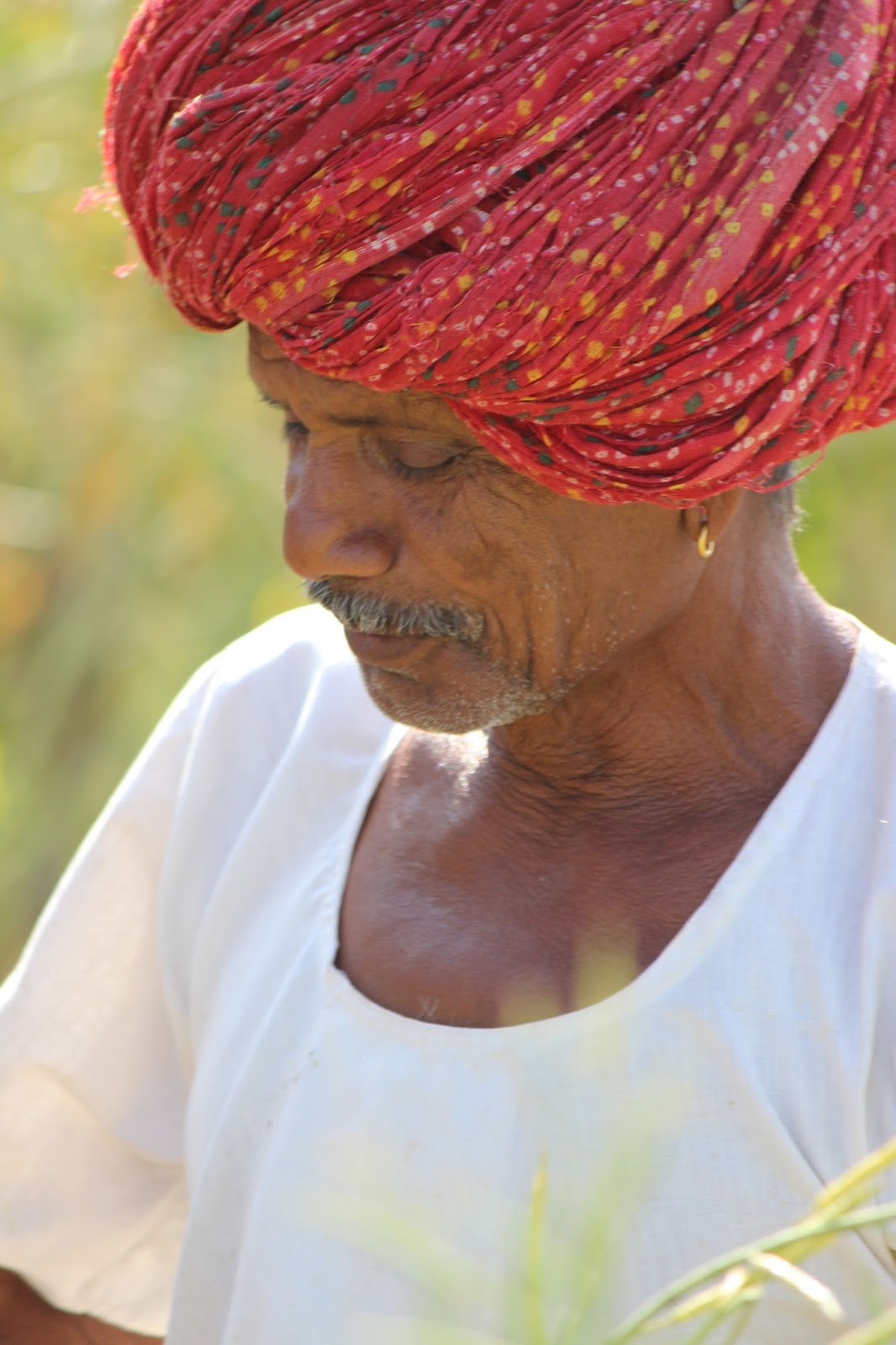
On Sunday we went for a visit to a local farm and village (this is the farmer, above). The farm was on part of the land that had been irrigated after construction of the dam. The family that owns the farm was in the field harvesting canola. Jai and his brother Raj talked about farming methods. Much of the farming was done by hand. Although the work was hard, it gave the family advantages in how they planted and when they harvested. They mostly used organic methods, though occasionally had to use a pesticide if other methods did not suffice.
Four brothers owned the land, but the farm was worked by two of their brothers and their families. The other two brothers were sent off by their father to Bangalore when they were 16 and 14 or make a living. They own a paint store now and are doing well enough to have built a large house next to the farm, which they live in when they visit. This may be the last generation doing family farming, as the children of the brothers who are working the land show little interest in taking over.
The farmers in the area live near their farms. One member of the family must sleep in the fields to keep watch with dogs for elk, who would destroy the crops. Shepherds and crafts people live in a nearby village. The shepherds work with the farmers, using grazing land and providing the farmers with fertilizer. We saw goats and sheep and an occasional cow.
We first visited an older man who was a retired shepherd. He was making yarn from goat hair, which he weaved into rugs and blankets. Then we went to the home of a family where the father made pottery and also clay roof tiles and his wife decorated the pots and also did clothing alterations. As with the farmer, the potter's children were not interested in continuing the craft.

Back at the camp, we had a cooking demonstration by the wife of one of the brothers who own Chhatra sagar. She oversees cooking in the restaurant. The approach is fresh and local ingredients. She also talked about using spices to bring out clear flavors. Rather than mixing lots of spices, as is often the case in restaurants she uses fewer spices which brings out distinct flavors better. That is more typical of Indian home cooking, particularly from the Kerala region, which is where she grew up. The approach was evident in all our meals, fresh food that tasted wonderful. Each dish in the meal complemented the others with its own distinct flavors.
We ate with the other guests in the outdoor dining area. The family ate in their own dining room. Though they had the same food, we did learn that their versions were hotter. We thought we were tolerating the heat well, but apparently we were getting milder versions.

The breakfast was particularly good. It started with home-made yougurt that was lightly sweetened with honey and had bananas and fresh pomegranate seeds on top. Then there were fresh eggs scrambled with veggies and Indian spices. Many of our meals have been vegetarian or had one chicken or mutton (goat) course. The meals have been satisfying because of the freshness of ingredients and the spices. The occasional meat dishes have been excellent, too, like the outstanding mutton in a red sauce at Chhatra sagar.
Jodhpur February 13-15
We said goodbye to Chhatra sagar and traveled by bus to Jodhpur. It was an exciting ride. The roads were rougher than on our previous trip, but with the usual chaos of tuk-tuks buses, motorcycles, cows and other occasional vehicles and animals.
We did learn why cows gather near the road or in some cases as we saw at one point lay down in the middle of a busy intersection. It turns out that the car exhausts keep the flies off the cows. Smart cows in India.
Our hotel is in the old section of Jodhpur. To get there we got off the bus a couple of kilometers away and transferred to tuk-tuks for another exciting, hair-raising ride. Think the car chase in The French Connection. We walked through the entrance area into the courtyard and there looming above was the great fort of Jodhpur, Mehrangarh. We have a wonderful view of the Fort from our room.

After lunch we walked through the nearby markets. What struck us was the great variety of fresh grains, fruits and vegetables, things we don't usually see. There were flies around the food, which is why everything need to be cooked before eaten, but it is really a rich array of food choices. We have certainly been enjoying eating some of these things.
We began the next day with visits to local artisan. We saw traditional tie-dying. In the first place we visited, we saw the dying process of cloth that had been tied. Later, we visited the home of a family where the women worked tying knots in cloth. They sat around in a circle, talking and tiring knots and were very gracious in showing us how they worked. They get paid 10 rupees a cloth and can do 5 cloths a day, earnings of 50 rupees, or about 80 cents.
We Also visited the workshop of a man who made sesame oil using traditional methods. The government had helped him buy a press. The oil was clear and good tasting.
In the afternoon, we went to the great Fort and Palace, Mehrangarh, which hovers over the city. Begun in the 15th century, the Fort was notable for it's impregnable location on top of a steep ridge and the beauty of the art work.
Wednesday February 15

The day mostly involved travel to Udaipur. Our hotel, the Taj Lake Palace, is located in the middle of the lake that Udaipur is built around. Once a palace of the king, the hotel is opulent and beautiful with gardens and somewhat overdone decorations. We watched a performance of traditional dance and music before a quiet dinner of Thai and Indonesian dishes.
Thursday, February 16

Returning to the hotel, we had a cooking lesson from the head chef and his assistants. The dishes he showed us included samosas, fried okra, the tastiest dal we have had, and a fish dish in a delicate sauce. We have the recipes and plan to try them. Later on we came back to the restaurant and ate these and other dishes for dinner.
Late Sunday night we started the long trek home, tired, but satisfied with all that we had seen and experienced.
We took the hotel's boat over to the king's palace. Unlike any of the previous forts we had visited, this structure was never a military facility. We wandered through the maze of rooms, many decorated in a simple way, but some, like the king's bedroom were quite ornate with mirrors that reflected the gold and silver and jewels on the walls and tables.
After the tour we drove to a family-run restaurant in the city where we had still another outstanding meal of Indian delicacies.

Returning to the hotel, we had a cooking lesson from the head chef and his assistants. The dishes he showed us included samosas, fried okra, the tastiest dal we have had, and a fish dish in a delicate sauce. We have the recipes and plan to try them. Later on we came back to the restaurant and ate these and other dishes for dinner.
Friday, February 17
After a leisurely morning we flew to Delhi and settled in for the night at the Trident Hotel near the airport to prepare for our trip the next day to Agra. In contrast to the hotels we had been staying in, the Trident was modern in its architecture and decorations. It was luxurious but tasteful. We had a pleasant dinner of small plates from various cuisines --Indian, Chinese, Mexican, Mediterranean.
One of the surprises of the trip has been how good the coffee has been in the hotels. There has also been ample fresh fruit at every breakfast. Eggs were also quite tasty as were the Indian entrees.
Saturday, February 18
We took a taxi for the two and a half hour drive to Agra, home of the Taj Mahal. The road is a modern toll road, well-maintained and relatively fast. That afternoon we toured the Agra Fort, and went to a park across the river from the Taj Mahal to see it at sunset.
Sunday, February 19
An early morning so we could get to the Taj Mahal as the sun was rising. There was a long line, but it moved swiftly, and we were able to tour it with minimal crowding. We were somewhat surprised by the intricate mosaic work on the exterior, since in the distance it looks like all white marble. As you can see, there are designs, and, in fact, the entire Koran is done in ebony on marble

Late Sunday night we started the long trek home, tired, but satisfied with all that we had seen and experienced.


